OEM vs ODM for Fishing Tackle: Which One Fits Your Brand?
Short answer: OEM means the factory makes an existing product to your specification and puts your brand on it. ODM means the factory designs and develops a new product for you. OEM is faster and cheaper to start; ODM gives you a product your competitors do not have, but it takes longer and usually needs a mold. Many tackle brands start with OEM and add ODM products as they grow.
What OEM means in fishing tackle
OEM (original equipment manufacturing) in tackle usually means you choose a product the factory already makes, then customize the parts that matter for your brand:
- Your logo on the product, spool or packaging
- Your colors: lure paint schemes, line colors, thread colors for flies
- Your components: hook brand and size, split rings, swivels
- Your packaging: blister, header card, box, spool label
Because the product and tooling already exist, OEM needs no mold cost, samples are quick, and minimum order quantities are usually lower.
What ODM means in fishing tackle
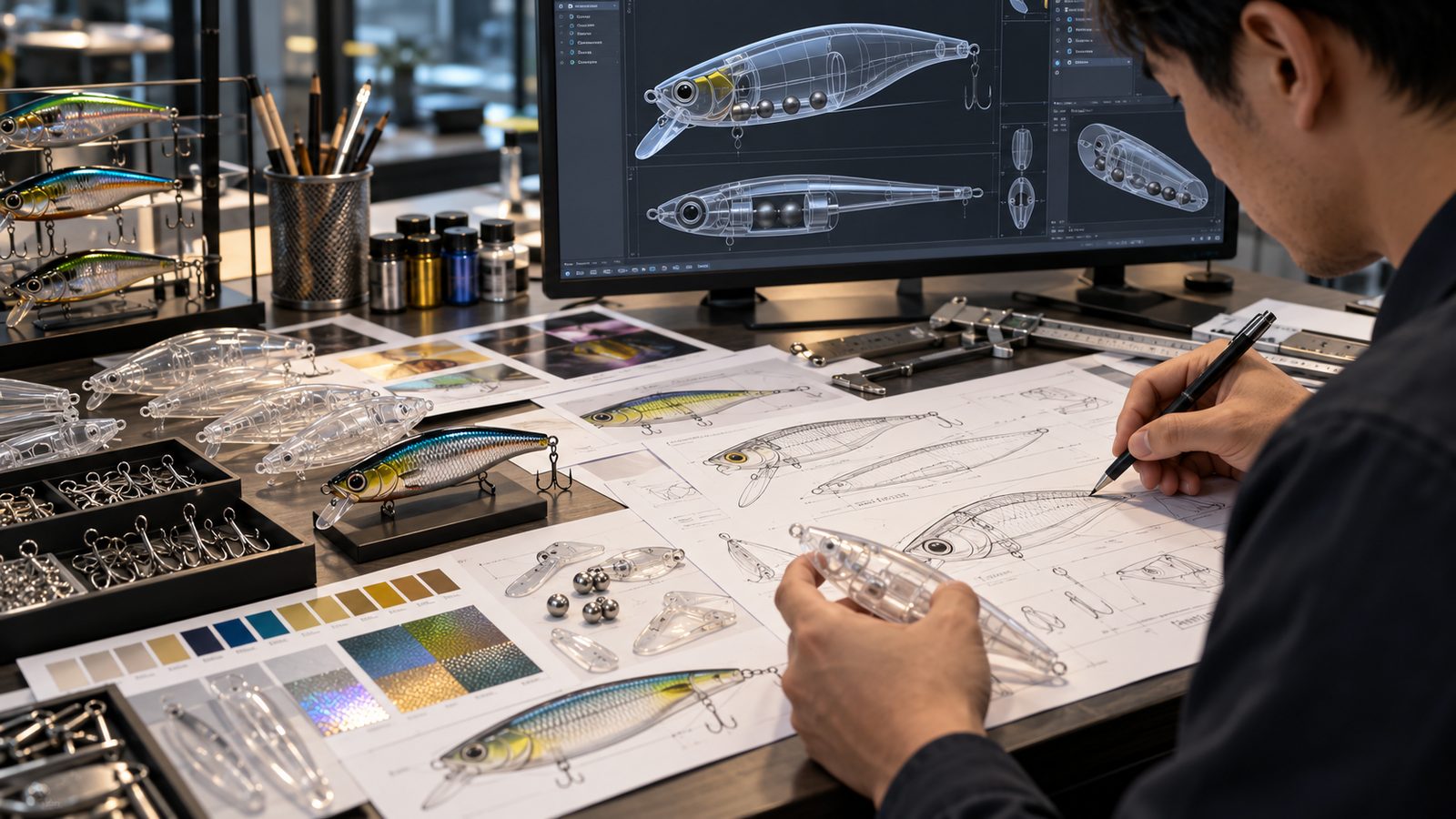
ODM (original design manufacturing) means the factory develops a new product with you. You bring a drawing, a sample, a competitor product you want to improve, or just an idea: target species, size, weight, action and price point. The factory then:
- Reviews the design for production and suggests materials and hardware
- Makes a prototype, by hand or 3D printing, for you to check
- Builds the mold after you approve the prototype
- Runs a small pilot batch
- Starts mass production once you approve the final sample
OEM vs ODM compared
| OEM | ODM | |
|---|---|---|
| Starting point | An existing factory product | Your idea, drawing or sample |
| What you customize | Logo, colors, components, packaging | The product itself, plus everything in OEM |
| Mold cost | Usually none | Usually yes, for molded products |
| Time to first order | Short: sampling, then production | Longer: design, prototype, mold, pilot run |
| MOQ | Usually lower | Usually higher, to cover the mold and setup |
| Uniqueness | Other brands may sell a similar product | A product only you sell |
| Best for | New brands, range extensions, fast-moving basics | Hero products, patented ideas, premium ranges |
Which one should you choose?
Choose OEM when you need to launch quickly, test a new category, or fill a range with proven products such as braided line, jig heads, swivels or ice jigs. The product works; your brand and packaging make it yours.
Choose ODM when a product is central to your brand, when you want something competitors cannot copy easily, or when you have found a gap in the market. A new lure body, a better carp rig component or a special fly pattern are typical ODM projects.
Combine both, as most successful tackle brands do: OEM for the core range and one or two ODM products that give the brand its identity.
How to protect your design
- Work with a factory that uses your logos, artwork and custom designs only for your orders.
- Agree in writing who owns the mold and the design.
- Keep the approved golden sample and use it as the standard for every order.
OEM and ODM at Jwell Fishing
Since 2002 we have produced OEM and private-label tackle for importers, distributors and brands in the United States, Canada, Australia and Europe. Our factory covers 3,000 m² with more than 200 people, and our range has more than 800 models: braided and nylon line, metal jigs, ice jigs, flies, carp rigs and lead core. For ODM projects we take your brief through design review, prototype, mold and pilot run, and you approve each stage. Samples are usually ready in about one week, and the sample fee is refunded when you place a bulk order. We ship on any common terms, and most customers choose door-to-door delivery.
Read how our OEM process works or tell us about your project.
FAQ
Is private label the same as OEM?
In tackle, the terms are often used the same way: a factory product sold under your brand. OEM can also include changes to the product itself.
Do I need a mold for an ODM product?
For molded products such as hard baits, soft plastics and many plastic components, yes. Line, flies and many rigs do not need a mold.
Who owns the mold?
Agree this before you pay. In many projects the buyer pays for the mold and it is used only for the buyer’s orders.